


If you’re a SaaS founder in 2026, you’re likely facing at least one of these problems:
- Your AI features are driving usage but making your most active customers the most expensive to serve.
- Your light users think you’re too expensive.
- Your compute costs are climbing faster than ARR.
- Your investors are looking beyond growth: they want predictability, profitability and healthy unit economics. That means you must meet or exceed the Rule of 40.
The uncomfortable truth? AI has rewritten the traditional SaaS pricing playbook.
Per-seat pricing doesn’t reflect value anymore. Flat-rate pricing doesn’t protect margin. And willingness-to-pay fluctuates faster than most pricing models can adapt.
It’s time for things to change. The companies that treat pricing as a dynamic system are the ones protecting margin and accelerating global growth.
3 ways AI has changed SaaS monetization - and what smart SaaS leaders are doing instead
Pricing and packaging no longer fit classic SaaS models, for three key reasons. Here we explain those reasons, and show you what smart SaaS companies are doing instead.
Change #1: Seat-based pricing no longer reflects value
Before AI, pricing scaled with headcount. It was simple: More users = more value = more revenue.
That’s now changed. Today, one AI-enabled employee can do the work of an entire team. “We're starting to see projects that used to require big teams now be accomplished by a single very talented person,” said Meta CEO Mark Zuckerberg in a recent earnings call with analysts.
We’re going to see 10-person companies with billion-dollar valuations pretty soon. In my little group chat with my tech CEO friends there’s this betting pool for the first year there is a one-person billion-dollar company, which would’ve been unimaginable without AI.”
The result of this change? Seat count no longer reflects output.
This creates two silent risks:
- You undercharge power users consuming heavy compute.
- You overcharge light users who never convert.
Neither of these scenarios is sustainable.
What smart SaaS leaders are doing
Instead of only offering seat-based pricing, leading SaaS teams are moving toward hybrid models. They combine a predictable subscription baseline with usage tiers or outcome-based differentiation to protect margin while preserving accessibility.
When CrashPlan introduced three subscription tiers to replace its one-size-fits-all package, it achieved a 100% increase in sign-ups.
Change #2: Compute costs introduce margin volatility
In the past, SaaS margins were based on predictable infrastructure costs. Gross margins of 70–90% were common.
AI has changed the game. Every prompt, inference, workflow, and automation carries marginal cost. If pricing isn’t aligned with usage, your best customers can quietly become your least profitable.
This isn’t just a pricing issue. It can eat into the economics of your whole business:
- 84% of companies report AI costs cutting gross margins by more than 6%.
- 26% say the impact is 16% or more.
What smart SaaS leaders are doing
High performing SaaS teams are far more intentional about how they package AI capabilities. Instead of bundling AI features into existing plans as free upgrades which costs the company, leading teams separate AI-powered functionality into differentiated tiers or add-ons.
Change #3: Willingness-to-pay is fragmenting
AI makes your product global instantly. But value perception is still local.
In some markets, AI replaces expensive labor and drives dramatic productivity gains. In others, labor costs are lower, and perceived ROI is more modest.
Static global pricing struggles in this environment. You either leave money on the table in high-value markets or suppress conversion in price-sensitive ones.
What smart SaaS leaders are doing
Top SaaS players test willingness-to-pay before scaling adoption. They align pricing more tightly with measurable outcomes rather than features alone. Most importantly, they experiment continuously.
When Kaleido expanded globally with localized currencies and payment methods, it saw a 51% increase in conversion from customers in Hong Kong, Japan, Australia, and Canada.
Is usage-based pricing the future of SaaS?
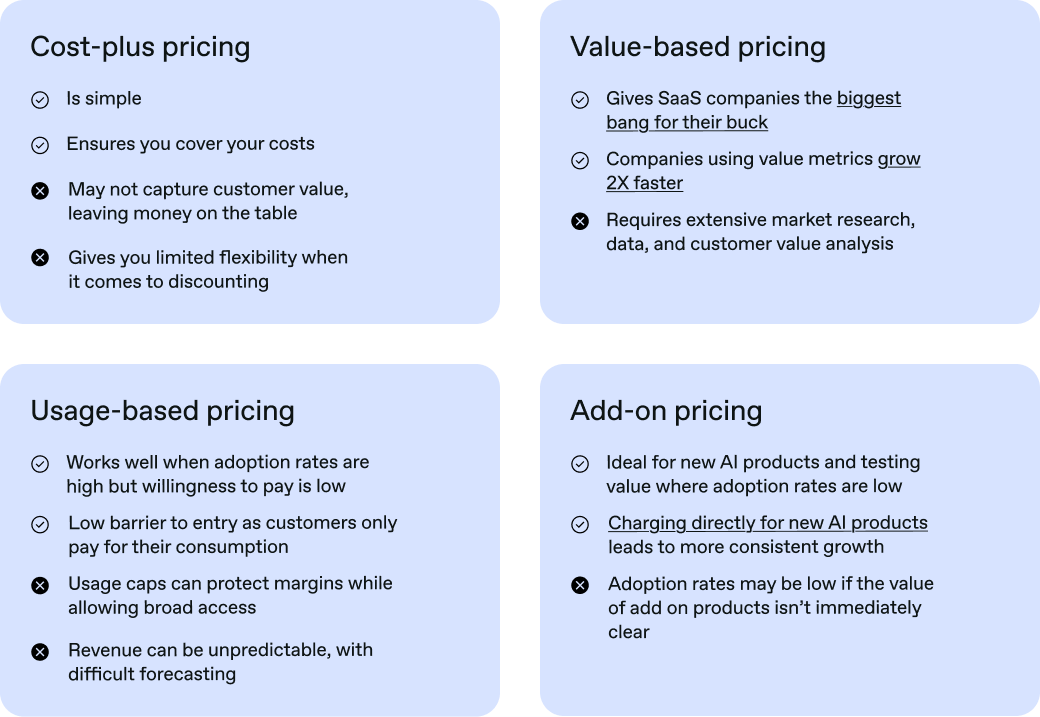
Usage-based pricing can work very well - but only in specific scenarios. It works best when adoption is high, value scales directly with usage, and you can reliably predict consumption. Otherwise, it can create unpredictable revenue swings.
That’s why many AI-focused SaaS companies are finding hybrid models more practical: a predictable subscription baseline, usage tiers that protect margins, and optional add-ons for advanced AI features.
What works for one company won’t necessarily work for another. But there is one universal truth: Static pricing is now the highest-risk strategy.
Your pricing infrastructure no matters more than ever
At a time when AI is accelerating everything - product cycles, competitive cycles, value delivery, and buyer expectations - your pricing system has to move just as fast.
Most founders think of pricing as a strategy problem. In reality, it’s increasingly a systems problem.
If your billing stack is rigid, every pricing change becomes a project. If your global tax and localization workflows aren’t automated, regional variation introduces operational drag. If your payment recovery processes are weak, expansion revenue quietly leaks through failed renewals and chargebacks.
The companies winning in the AI era aren’t just redesigning pricing models. They’re modernizing the infrastructure that supports them.
They’re building revenue systems that allow them to:
- Adapt pricing without breaking billing
- Localize intelligently without adding compliance risk
- Protect margins as usage grows
- Recover revenue automatically when payments fail.
Ready to learn more?
Our in-depth playbook gives you a deeper look at how leading SaaS teams are:
- Running disciplined pricing experiments
- Protecting margins from AI compute costs
- Increasing global conversion
- Recovering lost revenue
- Scaling without compliance drag
Download Staying in the fast Lane: The playbook to sell smarter and scale faster in the AI era


