

Steve P. Young is the founder of App Masters, where he helps app developers grow through marketing, ASO, and product strategy.
The app landscape has fundamentally shifted.
With AI-powered development tools making it easier than ever to build apps, the real challenge isn't creating products anymore, it's getting those products into users' hands and converting them into paying customers.

In this blog, I've identified the three biggest conversion challenges facing app developers in 2026, and the role web monetization can play in unlocking revenue growth. I also reveal the funnel and checkout tactics that are driving growth for some of the world's top app developers this year.
I recently co-authored a guide on this subject with Phil Carter and the team at Paddle. It's a great resource for teams who are taking growth on the web seriously in 2026.
The three biggest conversion challenges in 2026
Challenge #1: Channel-market fit (distribution)
With vibe coding becoming mainstream, app development has been democratized.
That's great for innovation, but terrible for distribution.
Traditional app store optimization alone won't cut it anymore. You're competing for attention in an increasingly crowded marketplace where everyone is fighting for the same eyeballs.
The web solution: Web2App campaigns give you control over distribution in a way that app stores never can.
Web2App has the fastest year-over-year growth of any owned media channel, outpacing Email2App, Referral2App, and QR2App.
When you own the web funnel, you own the entire relationship with your user from first click to final conversion.
Challenge #2: Creative execution
The distribution problem shifts priority to distribution, and as a result creative execution.
You need compelling creatives that drive people into your conversion funnel. The creative is what breaks through the noise and makes someone stop scrolling.
The problem is that creative execution has become exponentially more important at the exact moment that attention spans have gotten shorter and competition has intensified.
The web solution: App stores have strict guidelines on what you can say and show, your web paywall doesn't.
You can use social proof like "203 people purchased in the last hour," personalized discount codes, and countdown timers.
These psychological triggers are proven conversion boosters that app stores restrict or prohibit entirely.
Challenge #3: Speed and testing
Testing velocity matters more than it ever has. With AI making iteration faster and cheaper, the companies that can test and deploy quickly will pull ahead.
If you're still waiting days for app review cycles, you're operating at a disadvantage.
The web solution: Web campaigns are easier to iterate on than app store listings by an order of magnitude.
No waiting for App Review, no rejection risks. Want to test a new headline, pricing strategy, or upsell sequence? You can deploy it in minutes. Attribution is also cleaner - no ATT prompts complicating your data, no SDK implementation headaches, you can see what's working and double down immediately.
Google making lives easier for app growth campaigns on the web (see below) is a real sign of the times.
Seizing the opportunity: The anatomy of a high-converting web funnel
Of course diagnosing the issue and recognizing the opportunity is a fraction of the final solution.
How can app developers ensure success on the web?
No one app is the same, companies should test and iterate tirelessly to find out what works for them. But generally, there are a few guiding first-principles you should stick to when building out your Web2App conversion flow.
Dynamic routing
Don't create one generic quiz for everyone. Your ad creative should connect seamlessly to a customized first page and personalized quiz flow.
Companies crushing it with Web2App never take users straight to the app. Every ad leads to a web experience aligned with the ad's message. The continuity matters.
Hook them on page one
Industry averages suggest you're going to lose 50 - 70% of users on that first page.
Retaining more than 50% of users is always going to be tricky, but how can you minimize that retention figure? Here's a few tactics we like to stick to in most cases:
- Emotional messaging focused on outcomes, not features
- The use of personal language constantly, "your subscription" "your fitness journey"
- Clear problem/solution framing
- Immediate path to action (usually starting a quiz)
One message per screen
When it comes to your onboard flow or quiz, keep things simple:
- Don't overwhelm users: One question, one message, one screen.
- Mix quiz questions with social proof breaks.
- After 3-4 questions, give users a moment to breathe with testimonials or validation. This keeps them moving through the funnel without feeling interrogated.
The paywall that converts
You've retained users through your flow, how can you set yourself up for the moment that truly matters?
Again, it's all about testing, iterating and finding out what works best for your product, but here's what we like to recommend:
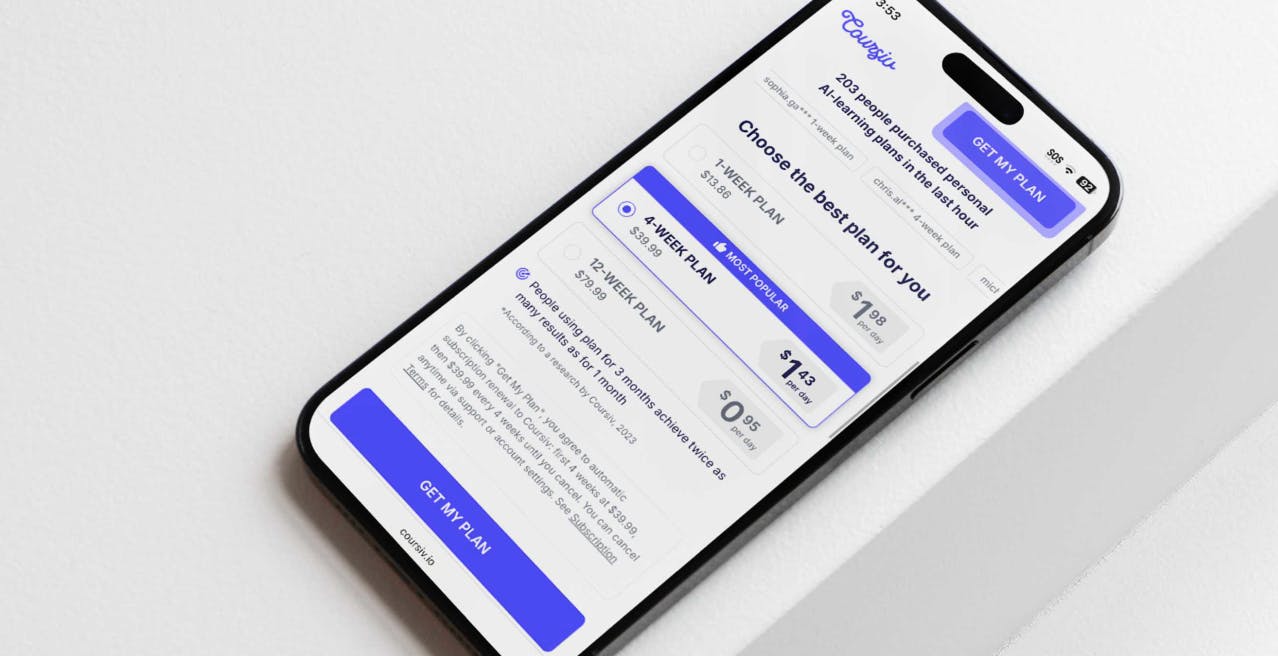
Hard paywalls: No trials. Make them buy. It sounds counterintuitive, but when positioned correctly especially with tripwire pricing (more on that later), hard paywalls convert better than trial offers.
Long-form paywalls: Longer paywalls consistently outperform short ones on web. Use the space to build desire, overcome objections, and stack social proof. Don't assume people won't scroll.
Time urgency: "Discount expires in 10 minutes" creates genuine FOMO. The key is making it real. If the timer expires and the discount actually disappears, users feel the loss. They'll be more likely to convert on their next visit.
Before and after visuals: Show the transformation. This works for fitness apps, education apps, and productivity apps. People buy outcomes, not features.
Per-day pricing: Do the math for users. "$1.07 per day" converts better than "$32 per month" even though they're the same price. The daily number feels manageable.
Personalized discount codes: Take their name and the current month to create a code like "STEVE_MARCH_2026." Real or not, it feels exclusive and personalized.
Social proof everywhere: Star ratings and testimonials. "91% of users stay with us after completion." User-generated photos, not illustrations.
Checkout optimizations: Apple Pay and Google Pay as default options. Money-back guarantees. Show what happens after purchase.
Upsells and downsells
This is hard to do in app stores but simple on the web and the revenue impact alone can justify a web funnel.
Checkout: Add a one-click upsell (“Unlock everything for $10 more”).
You can lift AOV by 15–25% with no extra acquisition cost.
Exit: Offer a meaningful discount (25–40%).
This can recover 10–15% of users who would otherwise leave.
Tripwire: A low-cost entry product ($3–10) designed to get someone to buy something quickly ($3-10)
The goal is conversion, not profit. It lowers CAC, drives faster payback, and increases the likelihood of future upgrades.
A good tripwire solves an immediate need, shows value fast, and feels like an easy yes.
Optimize for the right events
Finally, if you're running paid user acquisition, optimize for events that matter:
- Starting out? Optimize for Complete Registration or Initiate Checkout
- Scaling? Go straight for Subscribe or Purchase events
- Need more data? Start Quiz is acceptable, but move down-funnel as quickly as possible
Meta needs 50 events per week to optimize properly. Don't optimize for clicks, optimize for the business outcome you actually want.
Get the full playbook for growth on the web in 2026
The future of app growth lives on the web. The only question is whether you'll be early or late to the party.
Want to go deeper?
I've created a playbook alongside app growth expert Phil Carter and the team at Paddle.
Inside we break down every element of optimizing your web channel in 2026.