

You could be leaving hundreds of thousands of dollars on the table every year - simply because too many legitimate payments fail.

Most companies know their payment acceptance rate. Fewer know what the all round improvement is actually worth.
The challenge is that payment acceptance is usually treated as a single metric. In reality, it's the outcome of everything that happens before a customer clicks "Pay", the route that payment takes through the payments ecosystem, and what happens if that payment fails.
Put simply: payment acceptance is the output of multiple systems working at once. That is what payment orchestration means in practice and how each layer contributes to improving it.
Payment acceptance starts before authorization
Most discussions about payment acceptance begin with authorization rates. In reality, it starts much earlier. Customers first need to reach the payment stage, and they're significantly more likely to complete checkout when they can pay using methods they already know and trust.
A customer in the Netherlands expects to see iDEAL. A customer in Brazil is far more likely to pay using Pix. In China, Alipay may be the preferred payment method. If those options aren't available, many customers abandon checkout before an authorization request is ever sent.
Paddle data shows that enabling local payment methods increases checkout conversion from 4.3% to 6.5% - a 51% improvement.
Why payment routing matters
Once a customer submits a payment, another opportunity to improve acceptance begins.
Most digital product companies send every transaction through a single payment service provider (PSP). That provider may perform exceptionally well in one region. But no single PSP performs equally everywhere.
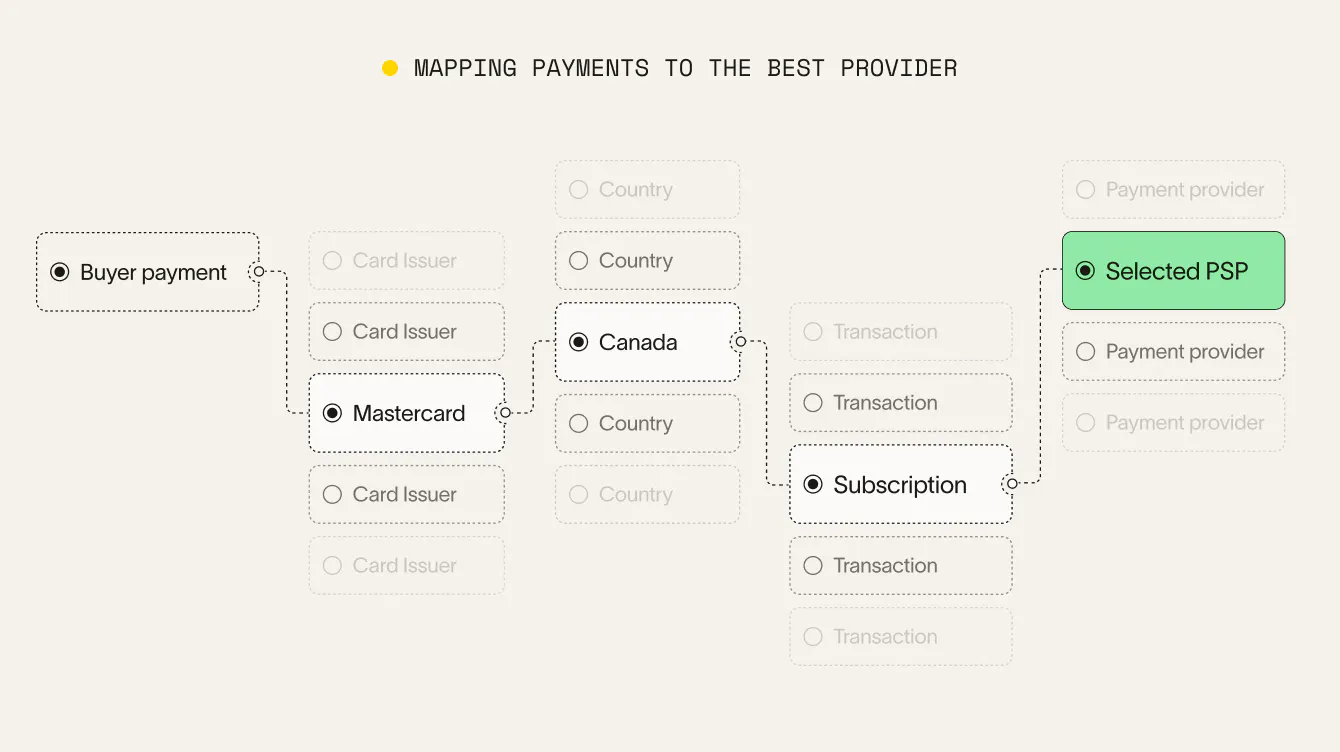
Authorization rates vary by country, issuing bank, card network, currency, and payment method. A transaction that Stripe declines may well be approved by another provider. Without orchestration, you never find out.
Rather than relying on a single provider, multi-PSP routing improves those odds by selecting the provider most likely to approve each transaction based on factors like geography, card type, local acquiring availability, and real-time payment performance. If the first attempt returns a soft decline, the payment can automatically cascade to another provider.
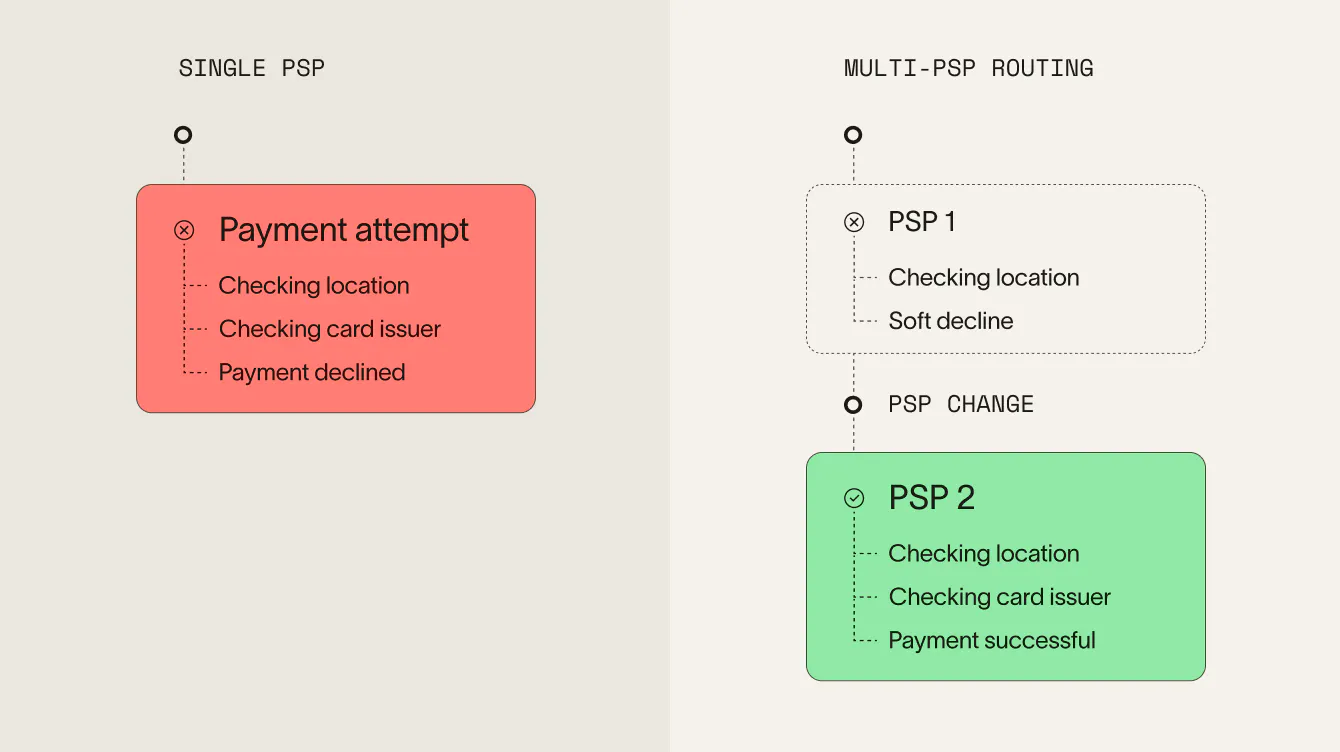
The customer never sees that complexity. They simply experience a payment that works.
Paddle has spent years building relationships with providers, so our customers have that orchestration from day one. This isn’t something you can build without processing the same volume of transactions that Paddle handles every day for over 10,000 businesses.
Studocu saw a 15% revenue increase after just 3 months of implementing Paddle. The team attributed this specifically to higher payment authorization in the US - their largest market. The edtech platform now has 95% payment success and 15% higher retention rates.
Payment acceptance doesn't end with the first attempt
Around 80% of payment failures are soft declines, meaning they occur because of temporary issues such as expired cards or network errors, rather than insufficient funds or a permanently invalid payment method.
That's why payment recovery matters. Well-timed retries, intelligent dunning, and effective fraud management can recover revenue that would otherwise be lost through involuntary churn.
Getting this right requires more than generic retry logic. Hammering retries on the wrong decline codes can damage your merchant identifier (MID), potentially forcing you to set up an entirely new merchant account, name, and company.
Outdated fraud tools that still view VPNs as a fraud signal, despite widespread use, cause legitimate transactions to fail. High chargeback rates, left unaddressed, damage relationships with payment providers and card networks, leading to more aggressive fraud screening.
Left unmanaged, these issues compound: each one increasing risk and eroding overall payment acceptance over time.
Paddle uses a third-party screening tool assessing IP, card history, and behavioural signals to catch fraudulent transactions without blocking legitimate customers. Our smart dunning software, built on years of transaction data and close collaboration with PSPs, cuts involuntary churn by up to 30%. With dedicated specialists fighting disputes on your behalf, new customers seeing an average of 50% reduction following migration.
Payment acceptance is the sum of many small improvements
Processing fees are easy to benchmark. Revenue lost through failed payments is much harder to see.
If you're reviewing your payment infrastructure, don't stop at the headline rate. Look at your authorization rates by region. Understand where payments are failing. Consider whether your payment methods reflect how your customers want to pay. And ask whether your payment infrastructure is helping you collect as much revenue as possible.
Because for many digital product businesses, the biggest revenue opportunity isn't just acquiring more customers. It's collecting more of the revenue you’ve already earned.
Paddle has years of transaction data, scheme programme experience, and close collaboration with PSPs to draw on to understand what actually moves the needle. That’s why our customers see 2-6% higher acceptance rates on average. Get started with Paddle today.
