
Key Takeaways
- Paddle data shows that offering local payment methods increases checkout conversion from 4.3% to 6.5%. Companies offering local currencies see 25% more conversions on average, with some seeing 5-10% lifts in specific markets like Germany and France.
- Mobile wallet optimization matters. Showing Apple Pay first at checkout increases conversion by 5.4%, while showing Google Pay first boosts it by 4.4%. One-click payments remove friction at the exact moment it matters most.
- Onboarding speed drives trial conversion. Companies that streamline their first-time user experience to reach the “aha moment” faster see significantly higher paid conversion rates.
Most SaaS companies spend thousands in customer acquisition costs through ads, content, and outbound sales. But the real revenue multiplier isn’t at the top of the funnel. It's what happens after a visitor reaches your pricing page, starts a trial, or enters checkout.
Small improvements at these conversion points compound into massive revenue differences because you’re optimizing customers you’ve already paid to acquire.
Conversion rate optimization (CRO) identifies and removes the specific friction points that stop qualified leads from becoming paying customers. It’s what separates a SaaS business that scales efficiently from one that burns cash on acquisition.
This guide shows seven ways to improve your conversion rates.
What is SaaS conversion rate optimization?
SaaS conversion rate optimization is the process of increasing the percentage of visitors who complete desired actions across your customer journey. Conversions can include trial signups, freemium-to-paid upgrades, and completed checkouts.
The goal is to increase conversion rates at each stage of your conversion funnel.
Unlike e-commerce CRO, SaaS companies deal with longer sales cycles, multiple decision-makers (especially in B2B SaaS), and complex product-led growth motions. So instead of just optimizing for one checkout page, you’re working the entire funnel from the first visit through onboarding to the first payment for your SaaS product.
The goal is simple: improve conversion at each stage so more qualified visitors become paying customers. But getting there requires a systematic CRO process backed by real customer data and clear CRO metrics.
What is a good SaaS conversion rate?
There’s no universal benchmark.
Industry averages vary depending on business model, pricing, traffic source, target audience, and more.
According to Ruler Analytics, the average conversion rate across 14 industries is 2.9%.
Trial-to-paid SaaS conversion rates typically range between 10–25%, depending on product complexity and onboarding flow.
Rather than comparing yourself to averages, focus on your own baseline:
- What is your trial-to-paid rate today?
- What is your checkout conversion rate?
- Where do qualified users drop off?
Improvement against your own historical data is the most reliable benchmark.
7 CRO strategies for SaaS products
The strategies below focus on high-impact areas where most SaaS companies miss conversion leaks.
Talk to your customers
Talk to the people who have bought and are currently using your product. Analytics and CRO tools show what users do, conversations reveal why.
Collect friction insights from:
- Exit surveys on pricing pages
- Sales call recordings
- Trial cancellation feedback
- Onboarding drop-off surveys
You could even incentivise this - Mayday offered their initial product for free in return for feedback, later migrating customers onto paid subscription plans.
Listen for repeated objections. Once you can see patterns, you can start removing conversion blockers that consistently come up. Even small changes can produce meaningful lifts.
For example, say you run a language learning software. A common complaint could be that users want to see a tutor’s availability before signing up. You could address that complaint by adding an availability calendar to your homepage. This was exactly what Preply did, which increased its trial conversion by 31%.
Run focused experiments with A/B resting
Most SaaS companies approach multivariate testing backwards. They run CRO tests on button colors and headline variations while ignoring fundamental issues in value communication.
Start with high-impact areas, like your:
- value proposition
- pricing structure
- onboarding flow
- checkout process
These drive more conversion optimization than any CRO experiment on button placement. Tools like Google Optimize can help you run these tests, but strategy matters more than tools.
Track both micro conversions (page views, video plays, feature clicks) and macro conversions (trial starts, paid conversions). Improving micro-conversions should ultimately improve your paid conversion rate.
Create landing pages for high-intent keywords
Your homepage can’t convert everyone. Different visitor segments need different messages, and generic pages simply wouldn’t cut it.
So instead of trying to talk to everyone, focus on your core audience. And if you have more than one core audience? Build separate landing pages for each major use case or industry you serve.
Say you’re selling a project management tool. You’d need different pages for construction teams, marketing agencies, and software developers. Each group has different pain points.
Use social proof relevant to each segment. If you’re targeting SaaS companies, show testimonials from other SaaS companies. If you’re targeting enterprises, prominently display your enterprise customer logos.
Here’s an example from Paddle. You’ll notice how the homepage includes logos of our ideal customers.

And then, later on in the page, we include relevant customer stories or testimonials for social proof.
Landing page optimization drives both customer acquisition and revenue growth while reducing customer acquisition cost over time.
Simplify your onboarding flow
Getting users to their first moment of value faster directly impacts trial conversion rates. Every extra step between signup and value realization increases drop-off across desktop and mobile optimization.
Test simplifying your onboarding flow in steps:
- Map your current onboarding and identify which steps are absolutely necessary and which are nice-to-have
- If a field doesn’t directly enable the core product experience, remove it or move it later in the journey.
- Show progress indicators so users know how many steps remain. A simple “Step 2 of 3” could reduce abandonment because people commit to finishing short tasks.
Focus your CRO process on removing friction.
Review your pricing and payment methods
People want to pay for your software, so make it easy for them. You don’t want a situation where a prospect is ready to pay, but is constantly hit with roadblocks. Here’s what you can do.
Offer local payment methods
Offering local payment methods increases conversion from 4.3% to 6.5%. So check where most of your customers are from and ask if you have the local payment methods they prefer.
If the answer is no, you’re missing a big opportunity to improve your conversions.
Currency localization matters more than most SaaS companies realize. Paddle data shows companies offering local currencies see 25% more conversions on average.
iMobie saw this lift firsthand. They needed to shift from licensed products to a SaaS model while fixing historically poor SaaS conversion rates. After implementing Paddle’s automatic localization with geo-specific pricing and currency calculations, they saw conversion rates 20% higher in Germany and France, and 10% higher in Japan.
Optimize mobile wallets for your users
Mobile wallets remove friction at the exact moment it matters most.
Showing Apple Pay first at checkout increases conversion by 5.4%, while prioritizing Google Pay boosts it by 4.4%. Your checkout should detect the user’s device and display the most relevant wallet option first, enabling purchase completion in just one tap.
Test different billing structures
Monthly subscriptions feel safer to customers, but annual plans reduce churn and significantly improve lifetime value. Companies using Paddle Retain to systematically offer annual plans see LTV up to 4x higher than with monthly-only billing. The conversion optimization happens through smarter pricing architecture, not just better checkout copy.
You don’t need to waste resource building and maintaining complex payment infrastructures either. Reduce engineering time integrating payment gateways, handling tax compliance, and debugging declined transactions by having a team of experts to do it for you.
Use AI to analyze customer patterns
Most analytics tools already come with AI features. So instead of just tracking what your prospects and customers have done, use AI to predict what they’ll do next:
- Track behavioral patterns across your highest-value customers. Which features did they use in their first week? What actions correlated with paid conversion? Feed this data into your CRO process to optimize for behaviors that matter.
- Analyze where qualified leads drop off in your conversion funnel. If analytics shows 40% of trial users never complete setup, that’s your biggest opportunity. Fix that friction point before testing headline variations.
- Run surveys asking paying customers what nearly stopped them from buying. These insights reveal friction points your analytics miss and help prioritize your CRO strategy.
Add product demos to high-intent pages
Video demos reduce uncertainty and objections faster than text descriptions ever will. Seeing the product in action answers questions buyers didn’t know they had.
Your demos should be placed prominently on your pricing page and key landing pages to give high-intent visitors immediate clarity. Don’t bury them in your resources section.
Test different demo formats for different audiences. Technical buyers might want detailed feature walkthroughs, while business buyers prefer outcome-focused overviews showing ROI.
The SaaS conversion rate optimization checklist
To improve your CRO, start by asking yourself the following questions:
- Are you offering local payment methods?
- Are you displaying local currencies?
- Are mobile wallets prioritized dynamically?
- Does onboarding reach value within minutes?
- Are you testing pricing architecture, not just headlines?
- Do you collect real customer friction data?
- Are you tracking trial-to-paid and checkout conversion separately?
Paddle: the payment stack to optimize SaaS conversion rates
Most SaaS businesses approach conversion rate optimization by testing their way to incremental improvements. You could hire a CRO agency or invest in CRO services, but prices add up and testing can still feel risky if your payment platform is unstable.
Paddle removes that friction entirely as your Merchant of Record (MoR). As your all-in-one payments platform, optimizations are easy and tests don’t derail your entire payment stack.
Our one-page checkout reduces the number of steps between decision and payment. Fewer pages mean fewer opportunities for buyers to abandon. Saved payment methods speed up repeat purchases for returning customers.
Paddle also presents the appropriate payment options based on the customer’s location. This intelligent optimization improves conversion across every market.
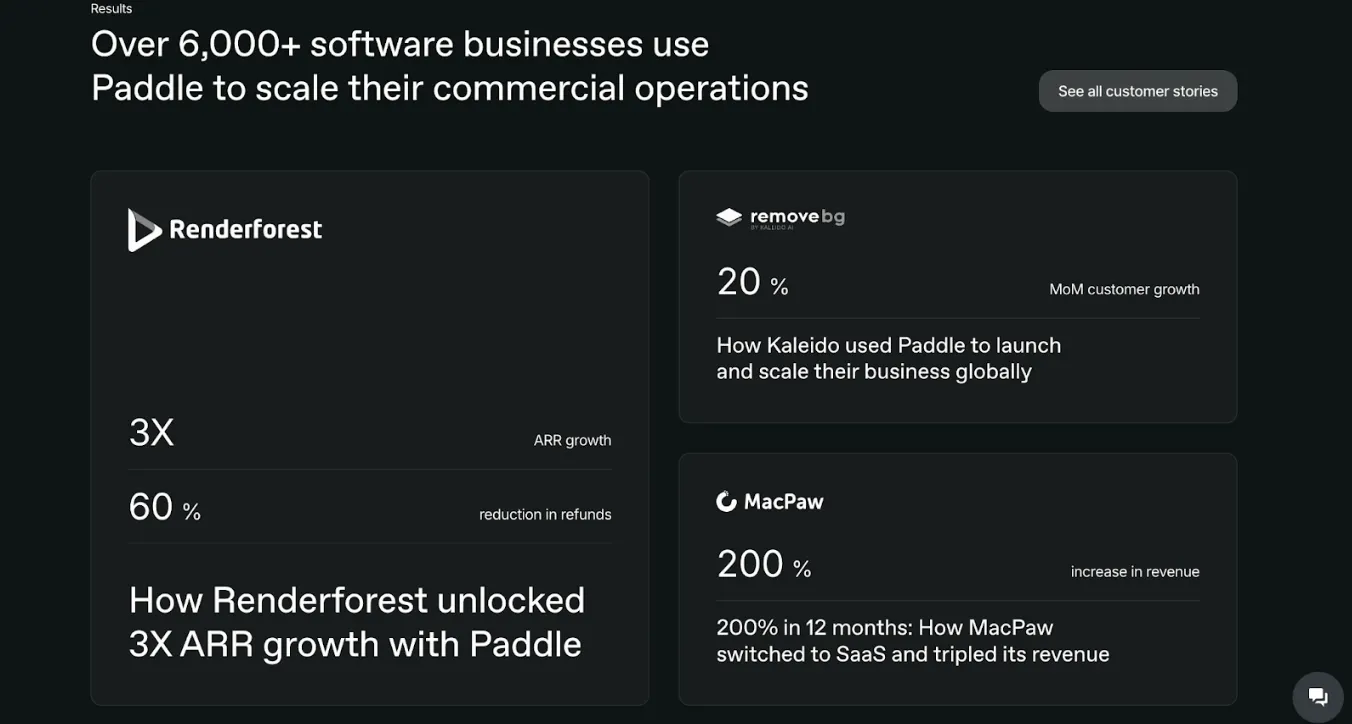
Kaleido launched remove.bg, an AI-powered background removal tool, with millions of free users but no monetization infrastructure. They needed to accept payments globally without building payment systems, handling tax compliance in 181 countries, or managing currency conversions.
After partnering with Paddle, they scaled from zero to 43,000 paying customers across 181 countries within 18 months of launch. Subscriptions became their fastest-growing revenue segment. The infrastructure that would have taken years to build internally was live immediately through Paddle.
Want to see how Paddle’s optimized checkout performs for your specific product and audience? Talk to our team about your conversion challenges.