


When businesses compare payment providers, they typically look at the transaction fee.
If one provider charges 3.5% and another charges 5%, it can feel as though the decision has already been made. But that comparison assumes both numbers are measuring the same thing - and they rarely are.
As you scale, payments become connected to almost every part of your business. Expanding into new markets means supporting local payment methods and currencies, managing tax and compliance across regions, preventing fraud, recovering failed payments, handling chargebacks, and helping customers with billing issues.
Finance needs accurate reconciliation. Product teams want to test and launch new pricing models. Growth teams need the confidence to enter new markets without rebuilding payment infrastructure. Individually, these requirements solve genuine business problems. Collectively, they determine what it really costs to support payments at scale.
Comparing transaction fees alone rarely gives you the full picture. Accounting for engineering time, compliance overhead, revenue lost to failed payments, and the markets you can’t expand into is the real comparison. That’s your total cost of ownership.
Looking beyond the transaction fee
A transaction fee doesn't capture the wider infrastructure needed to support a growing global business.
Tax, billing, fraud management, and customer support are all owned by different teams. As the business grows, additional payment providers, subscription platforms, fraud tooling, payment recovery, and reporting systems are introduced to manage the complexity of expanding across markets. Every investment makes sense, but the costs of supporting payments at scale grows with you.
Yet the biggest cost of a growing payments operation isn't always tooling fees. It's the operational work that develops around it.
Engineering spends time maintaining integrations instead of building customer-facing features. Finance reconciles transactions across multiple systems. Product teams find themselves constrained by billing capabilities. Expanding into another market is an operational decision - configuring tax, introducing new payment methods, and coordinating changes across several different platforms.
None of this suggests the original decision was wrong. The question is whether the architecture that supported your business three years ago is still the one that best supports the business you've become.
A different operating model
This is where a Merchant of Record (MoR), like Paddle, changes the conversation.
Rather than assembling and managing multiple tools and internal processes, a Merchant of Record becomes the legal seller for every transaction and brings together payments, indirect tax, fraud prevention, chargeback management, payment recovery, regulatory compliance, and buyer support within a single operating model. From day one.
For many, that’s one vendor, integration, and less operational complexity. The result? Your teams can focus on building products and growing the business.
The impact isn't only operational. Paddle customers typically see payment authorization rates improve by 2-6% across more 300+ countries, with a 50% average reduction in chargeback rates following implementation. Enabling localized payment methods can increase checkout conversion by up to 16%, while some customers have achieved 25% higher payment acceptance and 20% higher net revenue retention after moving to Paddle.
Runna chose Paddle to expand their web monetization strategy, rather than building and maintaining the operational infrastructure needed to scale globally (including tax compliance, payments, buyer support, and regulatory requirements). That shift led to a 15% increase in customer retention on web purchases.
If you're considering whether this approach is right for your business, our guide to evaluating a Merchant of Record explains the capabilities, trade-offs, and questions to consider before making the decision.
How the benefits of a Merchant of Record scales with you
When complexity arrives one requirement at a time, you solve each challenge with a new tool, process, hire, or partner. A broader payments operation, supported by multiple systems, internal processes, and teams across the business, risks deprioritizing your core projects time and time again.
The strategic question is no longer “What does our payment provider charge?” It becomes: “What does our payment operation cost the business?”
The true cost of payment infrastructure is measured not only in processing fees, but in:
- Missed conversions
- Revenue leakage
- Slower CAC payback
- Tax and compliance burden
- Critical engineering capacity pulled away from product innovation
The real value of a MoR like Paddle is how we help modern software businesses minimize operational drag, improve unit economics on customer acquisition, and enable reinvestment back into core product and growth activity.
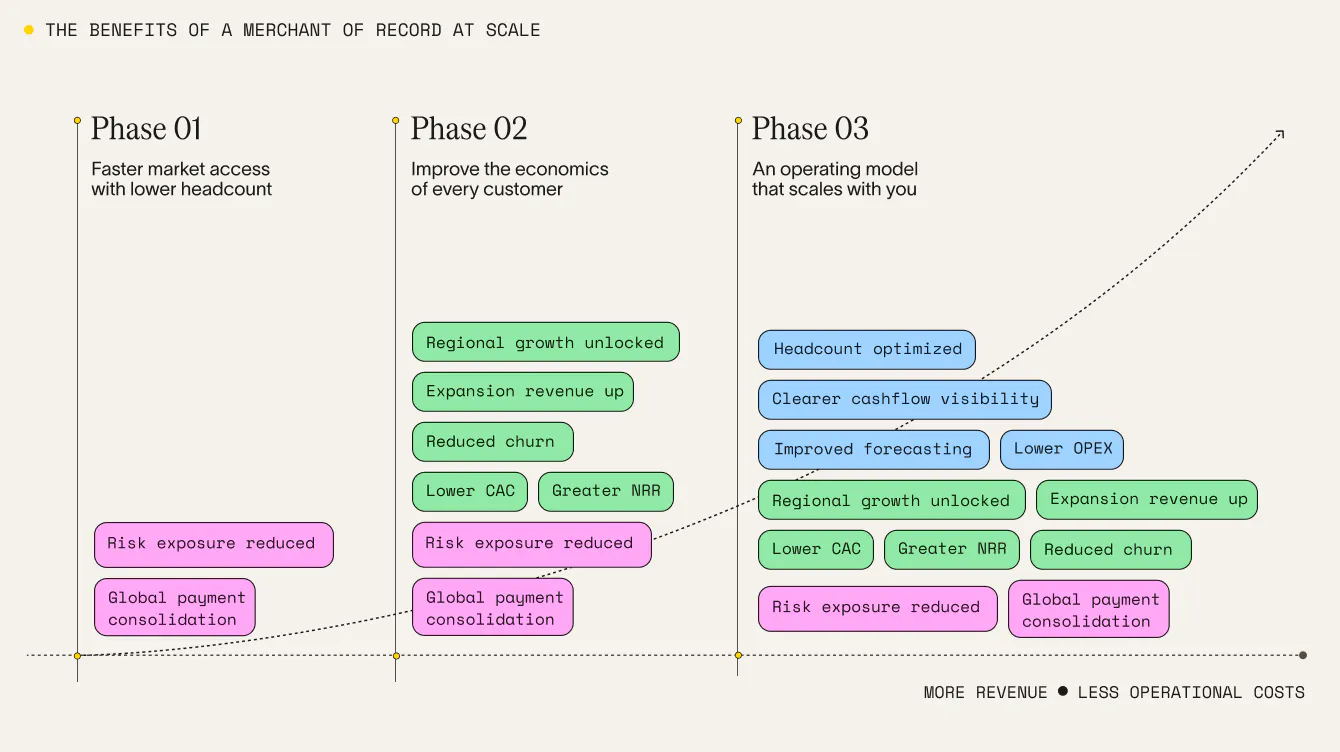
Phase 1: Access new markets faster with lower headcount
Net new revenue increases through faster market access without adding headcount.
Paddle consolidates the complexity of global payments into a single integration, immediately reducing your total cost of ownership.
The benefit is not simply fewer tools. It is launching internationally without compliance blockers, supporting local payment methods that increase conversion, a faster path from acquisition spend to cash collected, and less engineering effort spent maintaining and building payment infrastructure for new markets.
Phase 2: Improve the economics of every customer
Better payment acceptance reduces customer acquisition costs (CAC) while growing recurring revenue, and lifetime value (LTV) increases.
Paddle improves payment acceptance, recovers failed payments, and optimizes legacy revenue in the markets you already sell to. As more customers convert, renew, and remain active, overall churn reduces. Expansion is faster, CAC pays back sooner, and scaling feels easier.
Your acquisition spend works harder. The same investment with more retained revenue.
Phase 3: An operating model that increases margins
Margin increases through more efficient headcount and tooling decisions. You protect EBITDA and have more capacity to invest in product, growth, and market expansion.
Paddle consolidates multiple providers, gateways, entities, tax registrations, compliance processes, internal systems, and growing teams into one operating model.
The result is a more predictable cost base, less operational fragmentation, and less pressure to add headcount and systems in line with revenue growth.
Compare the full picture
We’ve built a calculator to help you compare the total cost of ownership.
Rather than assessing transaction fees in isolation, it helps you estimate the broader cost of your current payments setup and compare it with Paddle's Merchant of Record model.


